
Strategy implementation means putting the organisation's strategy into practice. When an organisation has a lot of personnel, implementation means a great deal of communication and participation, so that the changes the strategy aims for come alive in the everyday work of the personnel.
Ways of implementing a strategy
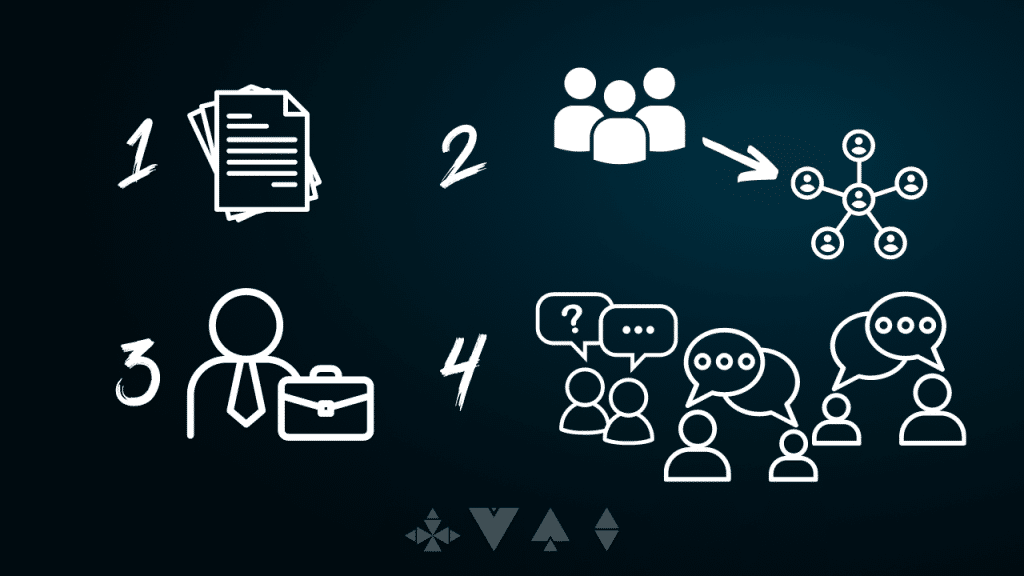
Traditional ways of implementing a strategy are: management telepathy, in other words no implementation at all; one-way top-down communication from management; two-way communication, in other words participation; and outsourcing the whole thing to consultants.
1. No implementation at all, in other words "management telepathy"
Traditionally, strategy has been rolled out from the top down without a single thought for participation or clear communication. The mental image is of ivory towers where the management, together with a consultant, cooks up a strategy in a magic cauldron, which after a hazy weekend emerges as a crystallised, gilded document for everyone outside to admire.
This document then ends up in the management's desk drawer, and at the next development days the management wonders why the personnel has not implemented the strategy, even though the management itself is not aware of what that strategy paper actually said.
In this case, the management imagines that the strategy is done once the plan has been made.
2. One-way communication
Strategy implementation is often understood as one-way communication, where the management decides on the new strategy and it is communicated to the organisation in beautiful terms and with the help of a slideshow. At the back of the management's mind is a timid hope that people will absorb the terms of the strategy slides and the new slogans like a sponge and thereby start working in a new way, more efficiently and better.
In reality, because of this approach, the strategy remains for the personnel something that does not touch their own everyday work. Indeed, for many the term "high-level fluff" is the first association when the organisation's strategy is mentioned.
This traditional way of handling strategy implementation assumes that the personnel will independently grasp the ideas of the strategy without being given the space, the place and the permission to process the strategy and the thoughts arising from it in relation to their own work.
3. Outsourcing strategy implementation to facilitators or consultants outside the organisation
The third way is to leave the entire strategy communication, strategy implementation and participation to a party outside the house. The challenges here are scheduling, expense, cost-inefficiency and the inability to execute and learn yourself. In this case, the discussions also easily turn into theatre rehearsals performed for outsiders, and getting to the core issues becomes harder.
4. Two-way communication, in other words participation
The fourth way to implement a strategy is newer and more modern. It is two-way communication and is often called participation.
There are many ways to carry out participation. Although participation is a fairly new method and term, it too has already experienced mild inflation in organisational vocabulary, because some of the things called participation are so-called "pseudo-participation", where the personnel's viewpoints do not really matter. The situation is a bit like the word "sales", which represents both knowledgeable and helpful selling and the world's slimiest car dealer.
The idea of well-executed participation, however, is that the personnel gets to process the strategy themselves, and what it means for their work. Participation gives the space, the time and the permission to deal with the subject.
Often, as part of two-way communication, the organisation authorises a small core group for strategy execution, often called change agents. The change agents' task is to communicate, remind, help and lead by example on the themes of the new strategy.
Stumbling blocks of participation
One way of doing participation is to use a ready-made slideshow or document template, whose walkthrough is delegated to supervisors, unit managers or change agents. This is already good, but it contains some stumbling blocks:
- It is assumed that everyone responsible for the walkthrough is an excellent facilitator
- It is assumed that people have the time to facilitate a discussion about the strategy and the skill to do it in a sensible amount of time
- There is no information on whether strategy discussions have actually been held and what has come out of them
- There is no information on what has been discussed and what conclusions were reached
- There is no two-way feedback on development proposals concerning the organisation as a whole
- The walkthrough still leaves it unclear to the personnel how the strategy can show up in their own work
- Slideshows are often "high-level" material, from which both the discussion leader and the team member find it hard to get anything concrete.
What working participation looks like in practice
The stumbling blocks can be avoided, and five organisations have described publicly how they did it. What they have in common is that the strategy was turned into conversation content of its own, the conversations were held in teams led by the teams' own managers or game masters, and every conversation left a record of what was discussed and what was concluded.
- HSL (Helsinki Region Transport) brought its new strategy into the daily work of 400 employees with 53 Topaasia sessions. Afterwards, 75% of staff said they understand the strategy well or very well.
- The City of Jämsä brought its strategy into conversations with 650 employees and the city council without heavy workshop days. Almost 90% of staff took part, and for the first time the conversations produced data as a basis for the strategy's key actions.
- Granlund implemented its strategy digitally for an expert organisation of more than 1,000 people. A core team designed a game of its own for the strategy, and staff played three themes alongside the CEO's live updates and other communication.
- The City of Turku built its own game content for the city strategy and the HR strategy, played by managers and teams. The goal is that everyone finds their own corner of the strategy, where it touches their own work.
- The Municipality of Laukaa wanted to get rid of the talking head and the sticky notes. In a municipal organisation of about 1,200 people, teams work through the strategy so that everyone makes choices and gets to voice their opinion.
In summary:
- Strategy implementation has traditionally been left undone, or done in various ways that have led to traditional strategic change initiatives failing for the most part.
- With good tools, involving people in the strategy is light, change-generating, rewarding and increases understanding across the organisation.
- Involving the personnel in the strategy is possible in a meaningful way without requiring external consultant help or extensive facilitation training
- The biggest challenges in strategy implementation are:
- The personnel sees the strategy as a "high-level thing", not as something that touches their own everyday work.
- The people who are made responsible for holding strategy discussions (often the organisation's supervisors) are overworked, and do not have the time or the desire to adopt demanding tools
- Good strategy implementation therefore needs clear, long-term and repeated communication on the matter, as well as proper participation. For this purpose, it is worth authorising a core group for strategy implementation, in other words for making it live in the everyday.
Where to start?
Strategy implementation succeeds when every team has one good conversation about what the strategy means in its own work, and management sees what came out of those conversations. You can start small: choose two or three themes from the strategy, hold the first conversations in a few teams and expand once the model works.
How this is done with Topaasia is described on the page Topaasia for strategy work. If you want to go through how strategy conversations would be rolled out in your organisation, book a demo. You can also try how the game works yourself with a free 30-day trial.
Read more:
Read more about strategy: download the Strategy Participation Guide
Blog article: Participatory strategy work - an interview with strategy communications expert Kati Kuoksa